Adolescent Therapy – Introduction
The most powerful social therapeutic intervention for working with adolescents is family therapy. Out of the multifaceted context impinging on the adolescents – family, peers, school, idols, culture – the ecologically orientated therapist starts with the pivotal point, which is the family. The family is a social environment out of which the adolescent emerged. It is the source of the most enduring relationships and the adolescent’s primary financial support. And the family frequently has the most resources with which to make changes.
Of all the social systems impinging on the adolescent, changes in the family have the most effect on the youngster. These changes include those within individual family members, such as midlife crisis, illness, and career decisions, as well as changes and family development, like children leaving home, divorce, and parents approaching retirement. The adolescent is extremely vulnerable to such contemporary changes within the family structure.
The existence of a disturbed adolescent in a family serves as the silent canary does in a mine – that is a tip off that there are problems in the system. In addition to being strongly affected by the family context, adolescents in turn affect the context of which they are part. The very presence of a troubled adolescent in the family creates pressures that require the therapist to pay attention to the other family members. It is only ethical that the therapist address the problems of the context as a whole. Not to do so – to treat just the adolescent in isolation – is to fail the other family members.
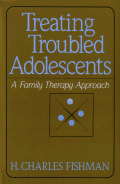
About Dr Fishman’s book:
Treating Troubled Adolescents
Publications on Adolescents
Fishman, H.C., Stanton, M.D., Rosman, B.L., Treating Families of Adolescent Drug Abusers. In Stanton, M.D., Todd, T.C. and Associates, The Family Therapy of Drug Abuse and Addiction. New York: Guilford Press, 1982.
Fishman, H.C., A Family Approach to Marijuana Use. Marijuana and Youth: Clinical Observations on Motivation and Learning, U.S. Department of Health and Human Services, Public Health Service, National Institute on Drug Abuse. Washington, D.C., 1982.
Minuchin, S., Fishman, H.C., The Psychosomatic Family in Child Psychiatry. Journal of the American Academy of Child Psychiatry, Winter, 1979.